Category: Uncategorized

  • Green Party reaction to Nigel Farage’s mass deportation plan

    Green Party reaction to Nigel Farage’s mass deportation plan

    Responding to plans announced by Nigel Farage to rip up swathes of international law and deport thousands of migrants if Reform UK ever gained power, Green Party MP Ellie Chowns said: 

    “More inflammatory rhetoric from Farage at a sensitive time in many communities. This dangerous toxic bluster is clearly aimed at whipping up anger, hatred and even disorder. The way he talks about asylum seekers – our fellow global citizens – is reprehensible.

    “The policy proposals themselves are unworkable. They rely on ripping up swathes of international law and would likely face many legal obstacles in the UK courts that could use British common law to block such cruelty. 

    “Iran, Afghanistan, Eritrea, Sudan and Syria feature in the top ten countries for asylum seekers in the UK  – all places where people face oppression, conflict, extreme poverty or famine. Asylum claims from people arriving from these countries have high approval rates – almost 100% in the case of Sudan and Syria [1]. 

    “Yet former Reform UK Chair Zia Yusuf has suggested that a Reform government would pay brutal regimes like the Taliban to accept the return of migrants – including unaccompanied children. They must know what could happen to these people when they are returned – they will likely be abused, tortured or executed. 

    “This is not who we are as a nation. The vast majority of the British public are willing to show compassion towards those fleeing the terrible situations they leave behind.”

  • Dismantling the Home Office – No Way Home?

    Dismantling the Home Office – No Way Home?

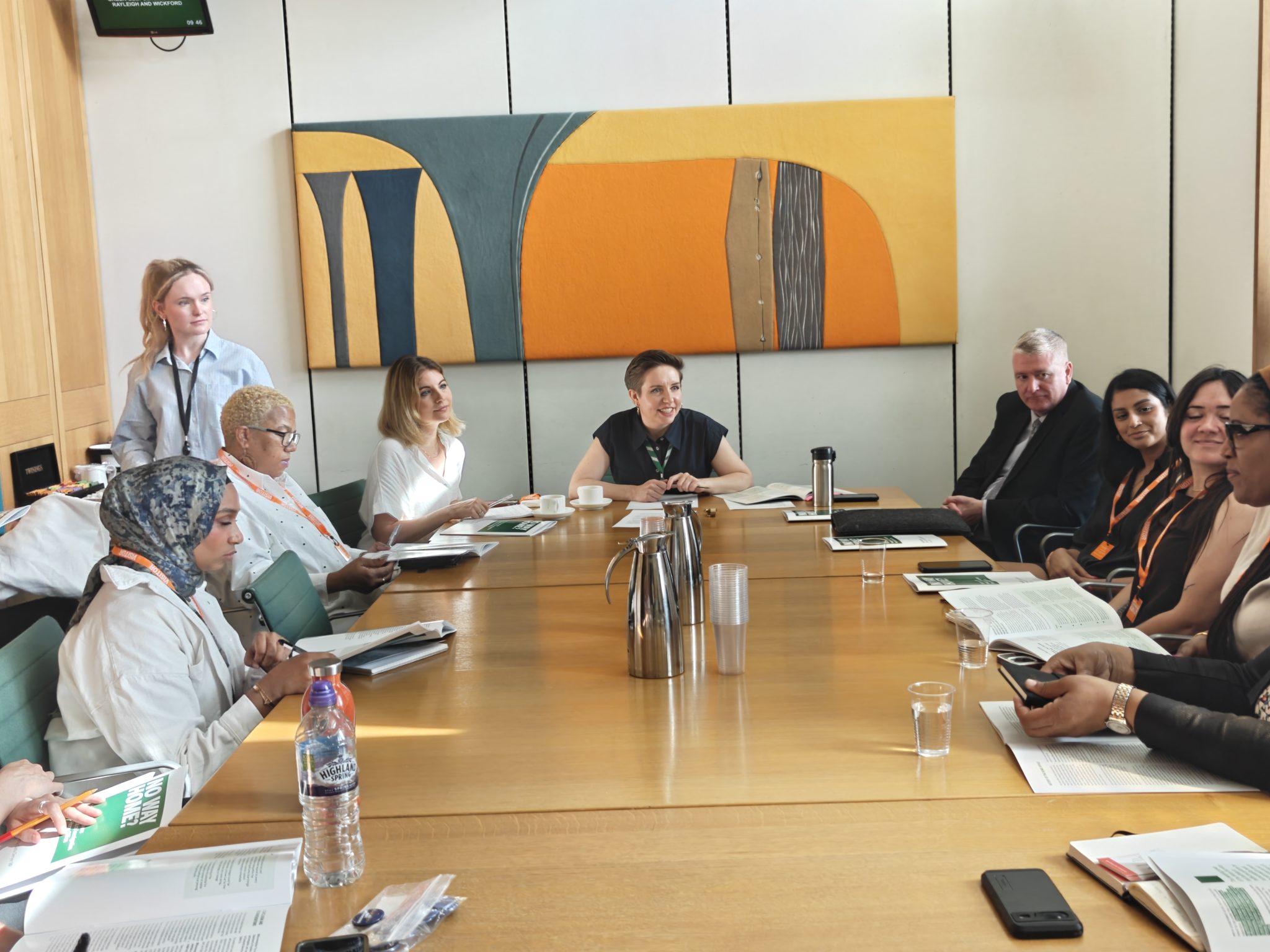
    Breaking up the ‘failing’ Home Office and replacing it with a department dedicated to infrastructure and integration would reset the UK’s ‘broken’ relationship with migration, said Green MP Carla Denyer, after a new report found that the Home Office is not fit for purpose.

    This confirms long standing Green Party Policy statements:

    RA400 The functions of the Home Office will be divided between a Department of the Interior and a Department of Migration, which, among other duties, will handle all applications for protection.

    MG300 The functions of the Home Office will be divided between a Department of the Interior and a Department of Migration, which, among other duties, will handle all visa applications.

    The report, ‘No Way Home?’ commissioned by Denyer and written by migration expert Zoe Gardner, finds that poor management of public funds, a lack of accountability, and a failure to learn from mistakes have led to repeated scandals – as a result of which all major stakeholders have lost trust in the department.

    Meanwhile according to Gardner’s analysis the Home Office’s remit itself leads to damaging outcomes, by linking immigration with security instead of addressing needs related to migration such as infrastructure or community cohesion.

    The report also highlights a wide spectrum of politicians, think-tanks, academics and experts calling for dismantling or radical restructuring, including Institute for Government and the Adam Smith Institute, as well as migrants’ rights organisations and criminal justice groups.

    Launching the report, Carla Denyer MP said that breaking up the ‘failing’ Home Office would be a crucial step towards re-setting the UK’s ‘broken’ relationship with migration.

    Carla Denyer, Green Party Co-Leader and MP for Bristol Central, said: 

    “Whether for it’s for work, for love, or to flee danger – people move, and it’s government’s job to make it work for us and our communities.

    “But decades of finger-pointing at migrants as a cover for government failure and neglect have broken this country’s relationship with migration – and the Home Office sits at the heart of the problem.

    “Rather than harnessing benefits of migration and effectively managing the challenges it throws up, the Home Office is designed to simply treat movement as a crime – resulting in families torn apart, taxpayer money wasted, and communities divided.

    “It’s time to get rid of the failing Home Office and replace it with a common-sense system to properly manage migration – one driven not by an imperative to drive down numbers or grab headlines but which instead is concerned with integration, infrastructure, and this country’s economic needs.”

    Zoe Gardner, independent researcher on migration who authored the report, said: 

    “Watching the political handling of immigration I see a startling complacency on the part of much of the Westminster bubble. Politicians from many parties are oblivious to the scale of change that the people of this country are demanding.

    “That change is going to come, and it could be positive and focused on ways to better support migrants and local communities. If not, it will be driven by racist narratives – and be very ugly indeed.

    “This report shows that the Green Party is taking that need for radical change seriously, and trying to steer us towards a more hopeful future.”

    You can read the full report here.
  • Right to Work for People Seeking Asylum

    Right to Work for People Seeking Asylum

    According to the National Audit Office, at the end of June 2024, the number of outstanding asylum claims awaiting an initial decision was around 86,000.

    In addition, the number of appeals against asylum decisions has increased, as of March 2024, the number of appeals in the first-tier tribunal chamber stood at 27,133 compared with 7,510 at March 2023 [1].

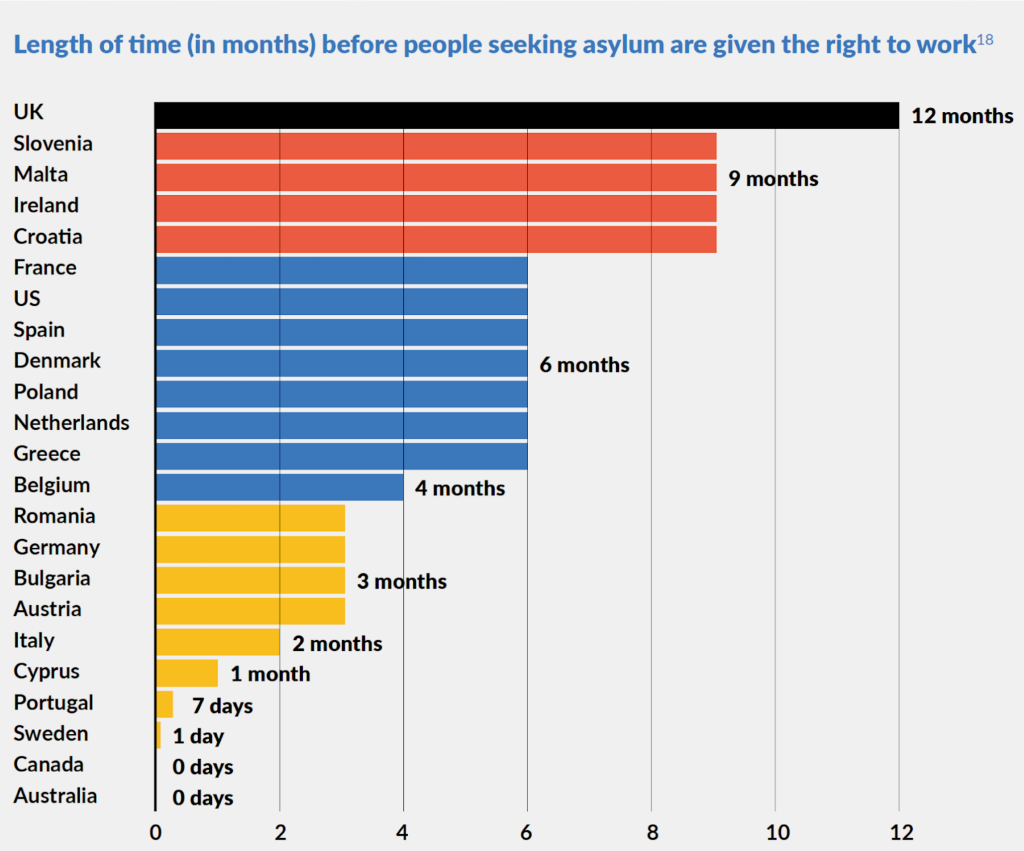
    Under the current system, people seeking asylum are not permitted to work until they have been waiting for a decision for over 12 months, and even then only in limited occupations and dependents are not eligible at all [2].

    The core issue here is the amount of time the Home Office takes to make a decision, and the quality of that decision. The Green Party policy commits to decisions being made within three months (RA 504) [3].

    It is worth noting that these delays are by design, and not just the result of an increase in applications, in fact although recent years have seen a rise in numbers, in 2023 there were a similar number to those in 2002 [4], with the levels regularly fluctuating due to global conditions.

    Until the backlog of decisions is cleared, and the Home Office has put in place the resources to ensure that they can process applications promptly and with care, we need to recognise the people waiting are suffering from these delays.

    Our policy RA 606 [5] is clear. All applicants of working age will be allowed to take up employment, with no restriction as to occupation.

    Why allow people seeking asylum to work.

    Allowing asylum seekers to work helps restore their dignity and sense of purpose. Being barred from working can lead to frustration and feelings of isolation.The right to work should be viewed as an essential human right.

    Many of the people seeking asylum are being supported financially and accommodated by the Home Office in hotels. In 2023-2024 this support costs £4.7bn [6]. Allowing them to work has the potential to reduce these costs significantly.

    Indeed, according to the Lift the Ban report, is estimated that the net benefit to UK economy of allowing people seeking asylum to work is £97.8m per year [7], based on a conservative estimate of only 50% of people who are currently waiting more than six months for a decision on their initial asylum application are able to work full time on the national average wage.

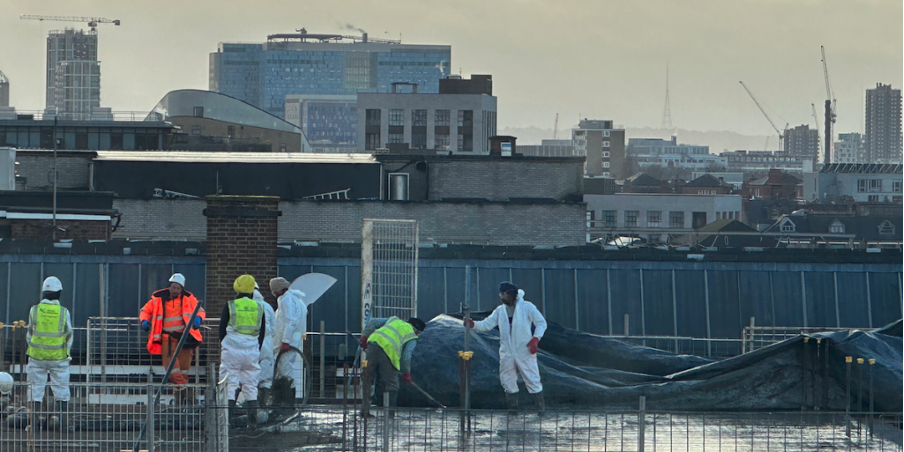
    The UK needs more workers, we have an acute labour shortage with 113k vacancies in the NHS [8] and 152k vacancies in the adult social care sector [9]. The hospitality sector is reporting a 55k shortage [10]. The construction sector is reporting that it needs 251k new workers with 31% of construction firms reporting difficulties in recruiting skilled workers [11]. We also have reported shortages of tech workers, seasonal agricultural workers, and teachers among other sectors.

    Imagine if the people seeking asylum, who are already living here, could be allowed to fulfil these vacancies. This is what happens in almost every other country in the world as shown by the graph below from the Lift the Ban report.

    Critics argue that allowing work rights may act as a pull factor for asylum seekers. However, evidence from countries like Germany and Canada, which grant earlier work rights, shows no correlation between work access and an increase in applications [12]. People seeking asylum are driven to move by safety concerns, not employment opportunities.

    In the UK, a recommendation for permission to work after six months has come from an  All-Party Parliamentary Group on Migration and the All-Party Parliamentary Group on Poverty in June 2024, along with various private members’ bills from the Scottish National Party in recent years [13].

    Conclusion

    The Green Party wants a fair and humane system of asylum. No one becomes a refugee lightly. People leave their homes, friends and often their family because they are forced to do so through circumstances that make remaining at home intolerable..

    We believe that people seeking asylum, and their dependents, should be allowed to work and start rebuilding their lives immediately on arrival to the UK.


    1. National Audit Office, An Overview of the Home Office for the new Parliament 2023-24, published October 2024.
    2. https://www.gov.uk/government/publications/working-whilst-an-asylum-claim-is-considered/working-in-the-uk-whilst-an-asylum-case-is-considered
    3. https://greenpartymigrationpolicy.org.uk/refugee-and-asylum-policy/
    4. https://commonslibrary.parliament.uk/research-briefings/sn01403/
    5. https://greenpartymigrationpolicy.org.uk/refugee-and-asylum-policy/
    6. https://www.refugee-action.org.uk/lift-the-ban/
    7. https://greenpartymigrationpolicy.org.uk/refugee-and-asylum-policy/
    8. https://researchbriefings.files.parliament.uk/documents/CBP-7281/CBP-7281.pdf
    9. https://www.skillsforcare.org.uk/Adult-Social-Care-Workforce-Data/Workforce-intelligence/documents/State-of-the-adult-social-care-sector/The-State-of-the-Adult-Social-Care-Sector-and-Workforce-2023.pdf
    10. https://www.ukhospitality.org.uk/insight/hospitality-workforce-strategy-one-year-on/
    11. https://ciobpeople.com/construction-workforce-forecast-highlights-ongoing-skills-gap/
    12. https://ecre.org/op-ed-pull-factors-the-myth-that-never-dies/
    13. House of Commons Library, Asylum seekers: the permission to work policy 26 July 2024
  • BBC migration coverage must get beyond the day-to-day political lens

    BBC migration coverage must get beyond the day-to-day political lens

    The Green Party Asylum and Migration Policy Working Group were pleased to be invited to contribute to the BBC’s thematic review of its migration output.

    Over a long and productive meeting we observed that the BBC’s coverage on immigration issues appears to be driven by the Government agenda and the (right wing) written press, this leads to the main talking points being “Stop the Boats” and issues such as the below:

    • Articles were labelled “Crisis” with little analysis about whether or not there is actually a migrant crisis, and what that would even look like.
    • Some longer articles contained different viewpoints but these were not generally reflected in the headlines
    • Articles about the possibility of leaving the ECHR had no mention of what it actually is and what rights we would lose. This reminded us of the BBC Brexit coverage and losing free movement, at that tome the focus was on inward migration but we not the rights we lost.. why so many are surprised they can no longer move to Spain etc.
    • Articles about the “need” to reform the Refugee Convention.. no analysis of the Home Secretary’s pronouncements questioning whether the application of the UN’s 1951 Refugee Convention is “fit for our modern age”.
    • BBC appeared to hold a neutral position when attacks on the judiciary were made
    • Little coverage on the effect of the hostile environment, search for NRPF has very few results mainly restricted to the pandemic.
    • Immigration Health Surcharge is nearly doubling in January, no news on website
    • No mention on the BBC website at all of the visa fees increasing? Huge issue causing hardship, making poorest in society to pay.
    • Only brief local coverage of the huge issue asylum seekers being forced into homelessness when they get a decision.
    • Negative messaging with phrases such as “Fortress Europe”, “Stop the boats”, “Illegal”
    • Coverage of Home Office accommodation focussing on costs, not on the decision delays causing the issues.
    • One sided choices of general public talking heads who aren’t challenged.

    A general point is we felt that the BBC was too focussed on migration being a political issue and not something that effects asylum seekers, refugees or anybody who crossed our borders and is trying to make a life in the UK. There is a little analysis of the harm caused by the hostile environment.

    The review was publised on 7th May 2024 here
    https://www.bbc.co.uk/mediacentre/2024/bbc-thematic-review-migration-output

    The BBC stated:

    Madeleine Sumption finds no consistent bias towards one point of view within the BBC’s coverage of migration and the quality of BBC coverage on migration has generally been high.

    However, her review does identify “risks to impartiality that point in multiple directions”. It identifies stories often being told through a narrow political lens, focused on commentary from a small number of high-profile people and without exploring issues in greater depth or detail.

    The review also finds that audiences need more context and explanation more fully to understand the background to migration stories, and that different types of migration should be explained more clearly.

    Sir Nicholas Serota, BBC Board Member and Chair of the Editorial Guidelines and Standards Committee said: “As recent events confirm migration is a highly contested area of public policy, and that is why BBC reporting on it must meet the highest editorial standards.

    “This Board-commissioned review finds that BBC coverage of migration has many strengths, but that it could also better reflect the topic’s complexities, as well as ensuring coverage is not overly dominated by political and high-profile voices.

    “We have asked the Director-General and the Executive to ensure all actions suggested in the review are implemented and the Editorial Guidelines and Standards Committee of the Board will monitor progress to ensure all the challenges raised are addressed.